


Event Planning vs Event Production: What’s the Real Difference?
Many businesses misunderstand the difference between event planning vs event production. The two terms are often used interchangeably, yet they represent very different responsibilities. Understanding this difference is critical for delivering professional, high-impact corporate events that run smoothly and leave a strong impression.
Whether you are organizing a corporate conference, product launch, or institutional program, choosing the wrong approach — or the wrong partner — can lead to delays, technical issues, and a disconnected audience experience. This guide explains the real difference between event planning vs event production, when you need each one, and why most successful events rely on both.
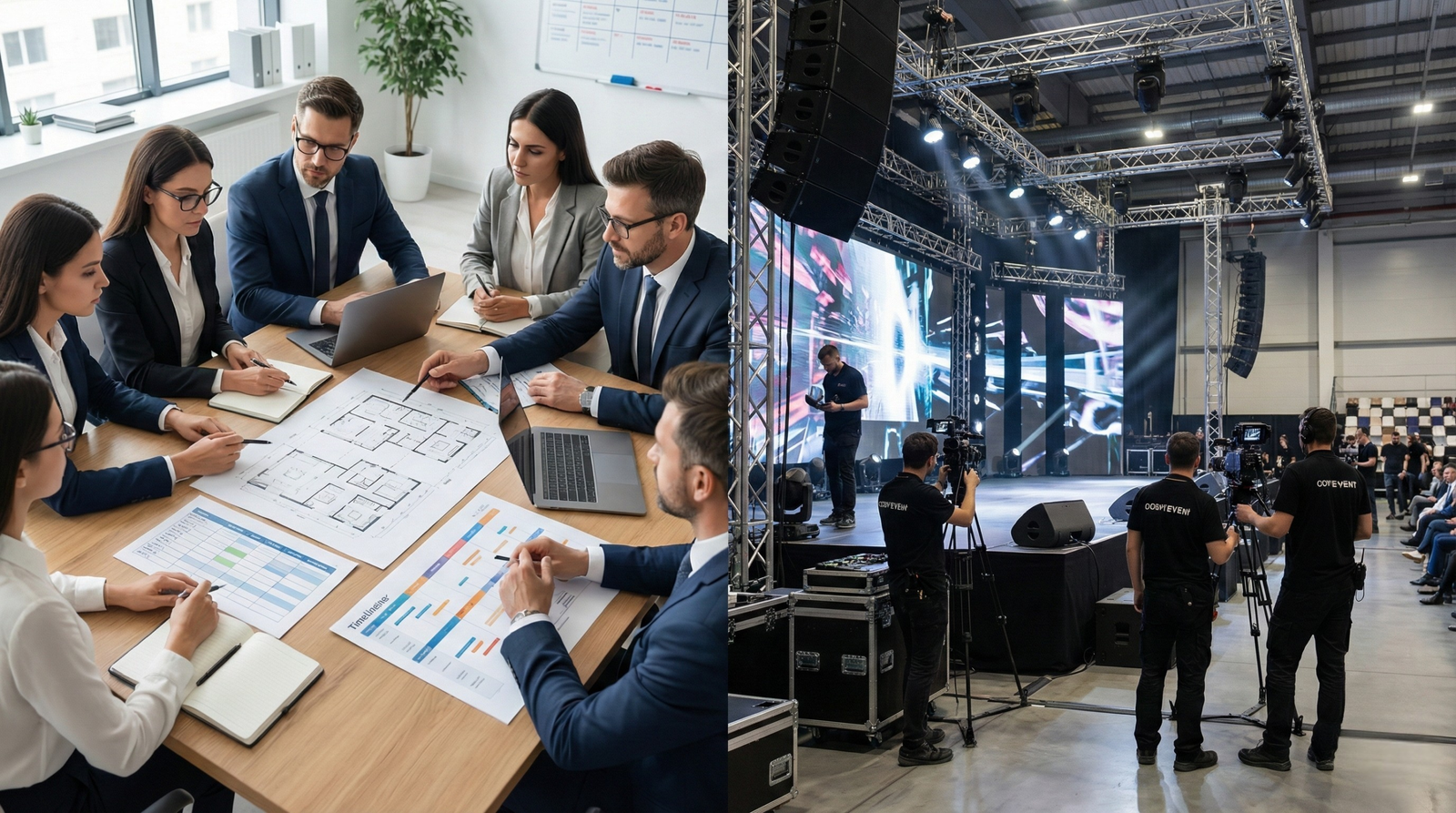
In simple terms, event planning focuses on structure, coordination, and organization, while event production focuses on execution, technology, and live delivery. Both roles are essential, but confusing one for the other often leads to unrealistic expectations and poor results.
In the next sections, we will break down what each role actually includes, how professional teams separate responsibilities, and how companies like event services in Jordan integrate planning and production into one coordinated system.
What Is Event Planning? (And Where It Usually Stops)
To clearly understand event planning vs event production, we need to start with what event planning actually includes. Event planning is the strategic and organizational side of an event. It focuses on structure, timelines, coordination, and ensuring that all moving parts are aligned before execution begins.
A professional event planning company works closely with the client to define objectives, budgets, schedules, and logistics. The planner’s responsibility is to make sure everything is prepared on paper before anything happens on-site.

Core Responsibilities of Event Planning
In most professional environments, event planning typically includes:
- Defining event goals, format, and target audience
- Budget planning and cost control
- Venue selection and coordination
- Timeline creation and milestone tracking
- Vendor sourcing and communication
- Guest list management and invitations
- Agenda planning and speaker coordination
From a client perspective, this stage feels like “everything is under control.” However, this is where confusion often begins in the discussion of event planning vs event production.
The Limitation of Event Planning Alone
Event planning defines what should happen — but not how it will be executed technically. Many planners do not handle stage engineering, LED systems, lighting cues, audio calibration, or live show control.
This is where many corporate events struggle. A schedule may look perfect on paper, but without professional execution, delays, technical issues, and misalignment appear during the live event.
For this reason, most high-level organizations in Jordan rely on integrated teams that combine planning with execution through structured corporate event management in Jordan , ensuring that strategy and reality match on event day.
In the next section, we move to the second half of the equation and explain what event production actually involves — and why it plays a critical role in the event planning vs event production discussion.
What Is Event Production? (Where Strategy Becomes Reality)
If event planning defines the structure, then event production is where everything becomes real. This is the execution layer that turns timelines, agendas, and creative ideas into a live, functioning experience.
Understanding event planning vs event production means recognizing that production is not about coordination — it is about control. Control over technology, timing, visuals, sound, lighting, and live decision-making.
What Event Production Actually Includes
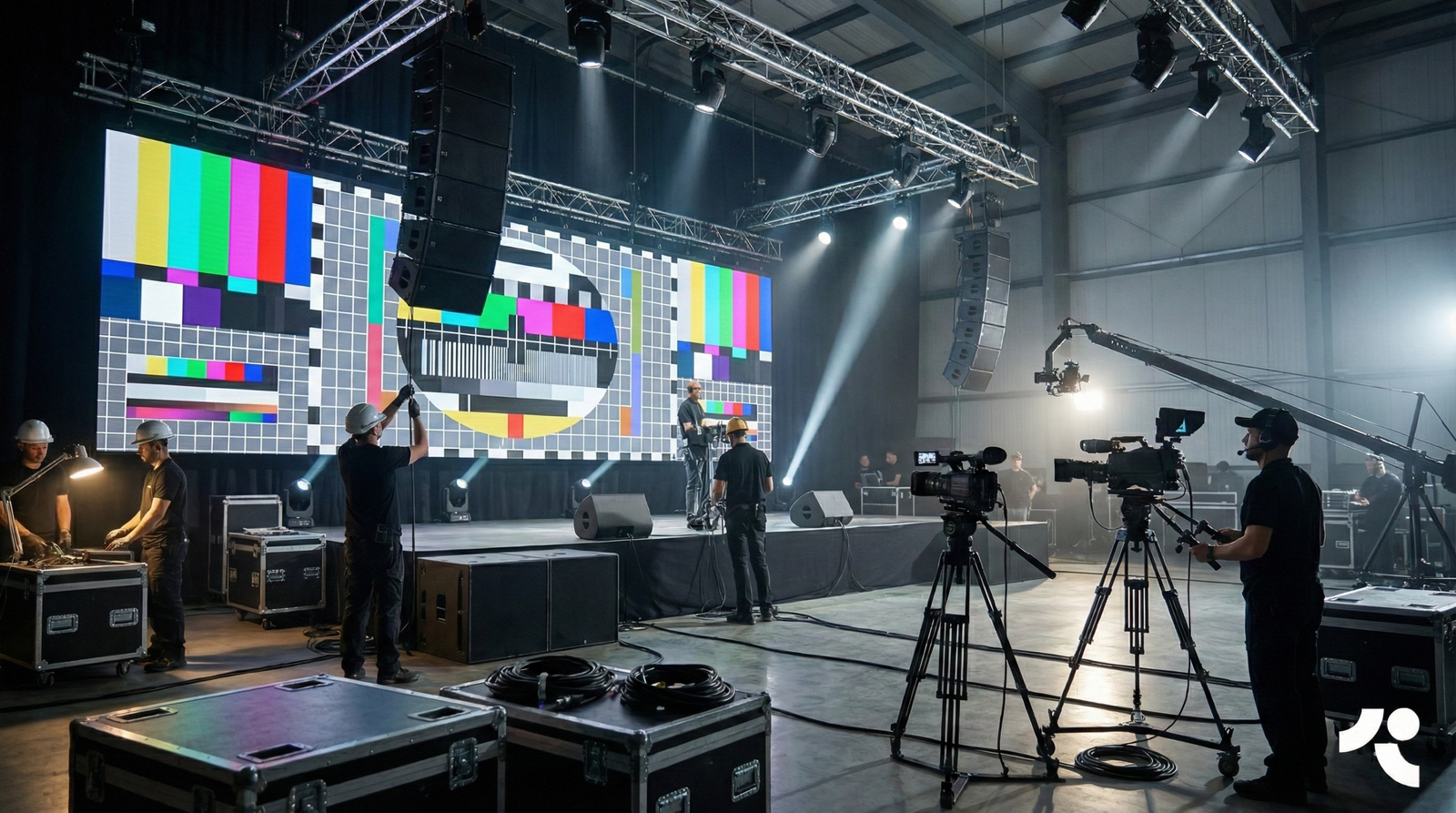
A professional event production company is responsible for every technical and creative element that the audience sees, hears, and feels during the event. This goes far beyond renting equipment.
- Stage design and structural engineering
- LED screen systems, resolution planning, and content mapping
- Lighting design, cue programming, and atmosphere control
- Professional sound systems and live audio mixing
- Show calling, cue execution, and real-time coordination
- Power distribution, safety checks, and redundancy planning
- Live troubleshooting and technical decision-making
This is why businesses that care about quality and brand perception work with specialists in event production in Jordan instead of relying on planners alone.
Why Event Production Is the Risk Layer
Most event failures happen during execution, not planning. Screens go dark, microphones fail, cues are missed, or transitions feel unprofessional. These problems only appear when event production is handled by inexperienced or under-resourced teams.
In the real world of event planning vs event production, production carries the highest risk — and therefore requires the highest level of expertise. This is why serious organizations choose integrated teams that combine planning and technical execution under one operational structure.
At Dot Event, production is treated as a controlled system, not a last-minute setup. Every show includes rehearsals, system testing, backup equipment, and live show control to ensure reliability under pressure.
This execution-first mindset is a core reason why companies searching for reliable event production companies in Jordan often prioritize technical depth over surface-level coordination.
Event Planning vs Event Production: What’s the Real Difference?
Many companies searching online for event support in Jordan don’t clearly understand the difference between planning and production. This confusion often leads to unrealistic expectations, budget issues, and execution problems.
To clarify event planning vs event production, the table below breaks down responsibilities, scope, and risk areas in a clear, practical way.
| Aspect | Event Planning | Event Production |
|---|---|---|
| Primary Focus | Structure, scheduling, coordination | Technical execution and live control |
| Key Responsibilities | Timeline, vendors, guest lists, agendas | Stage, LED screens, lighting, sound, show calling |
| Risk Level | Low to medium | High (live execution, no room for failure) |
| Technical Expertise | Limited technical depth | Advanced audiovisual and stage engineering |
| Live Decision-Making | Minimal | Constant, real-time adjustments |
| Who Should Lead? | Planner or project coordinator | Professional event production company |
This comparison shows why successful events rely on both roles — but never confuse one for the other. Planning sets the direction, while production carries the responsibility of execution.
Businesses that want predictable results usually work with teams that combine planning with full event production in Jordan , instead of separating responsibilities across multiple vendors.
When Is Event Planning Enough — And When Do You Need Full Event Production?
One of the most common mistakes companies make is assuming that event planning alone is enough for all types of events. In reality, the level of technical complexity determines whether planning is sufficient or whether full production is required.
Understanding event planning vs event production helps you avoid underestimating risks, budgets, and execution requirements — especially in corporate and public-facing events.
When Event Planning Alone May Be Enough
Event planning can be sufficient for low-risk, low-technical events where the focus is organization rather than experience design or live execution.
- Internal meetings or workshops with small audiences
- Basic seminars without stage production or live broadcasting
- Simple networking events in meeting rooms or offices
- Events with no LED screens, lighting cues, or complex audio systems
In these cases, the main risks are logistical, not technical. A planner can manage schedules, vendors, and guests without the need for a dedicated production team.
When Full Event Production Is Non-Negotiable
Once an event involves live audiences, branded visuals, or technical systems, planning alone is no longer enough. This is where professional production becomes critical.
- Corporate conferences and summits
- Product launches and brand activations
- Government or institutional programs
- Public screenings, fan zones, or outdoor events
- Hybrid or live-streamed events
These formats require structured technical planning, rehearsals, backup systems, and real-time control — all of which fall under professional event production in Jordan .
Why Planning Without Production Often Fails
Many companies hire a planner and then outsource production separately. This split responsibility creates gaps in communication and accountability.
Common problems include:
- LED screens that don’t match the stage layout
- Audio systems not designed for the venue acoustics
- Lighting cues that clash with presentations or branding
- No clear authority during live execution
This is why experienced companies prefer working with teams that handle both planning alignment and full production under one structure, especially in corporate event management in Jordan .
How Professional Teams Combine Event Planning and Event Production
The real difference between average events and exceptional ones lies in how event planning vs event production are managed together — not as separate services, but as one integrated system.
Professional event teams do not treat planning as paperwork and production as execution. Instead, they align strategy, logistics, creative direction, and technical delivery from the very first meeting.
Planning Decisions That Direct Production
In high-level events, planning decisions directly affect production outcomes. Venue selection influences lighting design. Agenda flow determines screen layouts. Speaker format impacts audio configuration and camera angles.
When teams understand event planning vs event production as a connected process, they eliminate guesswork and last-minute adjustments.
- Stage dimensions are designed based on content needs
- LED screen sizes are planned according to viewing distance
- Lighting cues are synchronized with agenda timing
- Technical rehearsals are built into the event schedule
This integrated approach is a core principle in professional event services in Jordan , where planning and production operate as one system rather than isolated tasks.
One Team, One Chain of Responsibility
One of the biggest risks in separating planning from production is unclear responsibility. When issues occur, teams point fingers instead of solving problems.
Professional teams avoid this by maintaining a single chain of responsibility. The same group that plans the experience is accountable for how it looks, sounds, and performs live.
This model is especially critical in corporate event management in Jordan , where timelines are tight, stakeholders are senior, and tolerance for error is minimal.
Why Integrated Teams Reduce Risk
Events fail not because of one big mistake, but because of multiple small disconnects. Integrated teams reduce these risks by controlling the full workflow.
- Fewer miscommunications between planners and technicians
- Clear authority during live execution
- Faster response to last-minute changes
- Consistent brand presentation across stage, screens, and content
This is why organizations planning complex or public-facing events increasingly prefer partners that deliver both strategy and execution under one roof.
Real-World Scenarios Where Event Planning vs Event Production Makes the Difference
The gap between event planning vs event production becomes most visible in real-world situations. These are moments where decisions made weeks earlier directly affect what happens on stage — and how the audience experiences the event.
Scenario 1: Corporate Conference with Multiple Speakers
In conferences, planning defines the agenda, speaker order, session timing, and breaks. Production translates those decisions into stage layouts, screen content, lighting cues, and audio transitions.
When event planning vs event production are disconnected, common issues appear: slides don’t display correctly, microphones are delayed, and speakers lose momentum. When both sides work together, transitions feel natural and the event flows smoothly.
This is why professional event production in Jordan relies heavily on early agenda alignment and rehearsals.
Scenario 2: Product Launches and Brand Activations
Product launches are highly sensitive to timing, visuals, and emotional impact. Planning defines the story: what is revealed, when, and to whom. Production brings that story to life through LED screens, lighting effects, sound design, and stage choreography.
If planning is strong but production is weak, the message loses impact. If production is impressive but planning is unclear, the audience leaves confused. Only when event planning vs event production work together does the launch feel intentional and memorable.
Scenario 3: Outdoor and High-Traffic Events
Outdoor events introduce variables that cannot be improvised: weather, power supply, crowd movement, visibility, and safety. Planning defines crowd flow, entry points, schedules, and contingency plans. Production ensures equipment stability, screen brightness, audio coverage, and structural safety.
In these environments, separating event planning vs event production significantly increases risk. Professional teams treat both as one system, especially in large public activations and seasonal campaigns.
This integrated model is essential for brands preparing for large-scale moments such as major tournaments and national campaigns, where execution errors are highly visible.
Scenario 4: Institutional and Government Events
Institutional events require precision, protocol, and strict coordination. Planning handles guest hierarchy, seating, timing, and messaging. Production ensures translation systems, audio clarity, lighting balance, and documentation coverage are executed flawlessly.
In this context, event planning vs event production cannot operate independently. Any disconnect risks reputational damage and operational failure. This is why institutions prefer partners that manage both layers together.
Common Mistakes When Event Planning vs Event Production Are Treated Separately
One of the most common reasons events underperform is the incorrect separation of event planning vs event production. While these functions are different, treating them as isolated tasks often leads to operational gaps, miscommunication, and avoidable failures.
Mistake 1: Planning Without Technical Input
A frequent mistake is finalizing the agenda, stage layout, and timing before consulting production specialists. This leads to unrealistic schedules, insufficient power requirements, or stage designs that cannot be executed safely.
In event planning vs event production, production input should be part of the early planning phase — not a last-minute addition.
Mistake 2: Assuming Equipment Equals Production
Many organizers believe that renting LED screens, speakers, and lighting automatically means professional production. In reality, equipment without programming, testing, and coordination is just hardware.
True event planning vs event production integration means aligning equipment with content, timing, and audience experience — not just installing it.
Mistake 3: Lack of Rehearsals and Technical Run-Throughs
Skipping rehearsals is one of the fastest ways to compromise an event. Without full technical run-throughs, teams discover issues live, in front of the audience.
Professional teams understand that event planning vs event production must converge during rehearsals, where timing, cues, and transitions are tested together — not separately.
Mistake 4: Fragmented Communication Between Teams
When planners, designers, technicians, and content teams work in silos, information gets lost. Changes are not communicated, responsibilities overlap, and last-minute stress increases.
Successful execution requires a unified command structure where event planning vs event production operate as a single system.
Mistake 5: No Single Point of Accountability
When planning and production are handled by different parties without clear leadership, problems escalate quickly. Everyone assumes someone else is responsible.
This is why professional setups assign a central production lead who bridges event planning vs event production and maintains full operational control.
How Professional Teams Align Event Planning vs Event Production
The difference between a stressful event and a seamless one is not budget or scale — it is how well event planning vs event production are aligned from day one. Professional teams treat planning and production as two connected systems, not separate responsibilities.
Alignment happens when strategic decisions, creative direction, and technical execution are developed together — not handed over from one team to another at the last minute.
One Unified Timeline, Not Two Separate Schedules
Professional teams operate using a single master timeline. This timeline connects planning milestones (concept approval, agenda confirmation, speaker coordination) with production milestones (technical drawings, equipment testing, rehearsals, and show cues).
In effective event planning vs event production workflows, no task exists in isolation. Every decision is evaluated based on how it affects execution on the event day.
Early Technical Involvement in the Planning Phase
Instead of bringing production teams after planning is finalized, professional organizers involve technical leads from the start. This allows realistic stage designs, accurate timing, and correct power, rigging, and safety calculations.
This early collaboration is where event planning vs event production stops being a conflict and starts becoming a strength.
Clear Roles With Centralized Decision-Making
Alignment does not mean everyone does everything. It means everyone knows exactly who decides what. Professional teams define clear roles for planners, producers, technical directors, and content teams.
A central production lead ensures that event planning vs event production remain synchronized — especially when changes happen.
Integrated Rehearsals and Full Run-Throughs
Rehearsals are where alignment becomes visible. Professional teams rehearse the full experience — not just speeches or visuals, but transitions, lighting cues, audio levels, and audience flow.
This is the final checkpoint where event planning vs event production are tested together as one system.
When Do You Need Event Planning, Event Production, or Both?
Understanding event planning vs event production helps organizations choose the right partners and avoid unnecessary costs or execution risks. Not every event needs the same level of involvement in both areas.
You Mainly Need Event Planning When:
- The event format is simple and low-risk
- The venue already provides basic technical infrastructure
- The focus is on guest coordination, agenda flow, and logistics
- Branding and visuals are minimal
In these cases, planning focuses on structure, communication, and making sure everything happens on time.
You Mainly Need Event Production When:
- The event includes LED screens, lighting design, or live broadcasting
- Visual storytelling and stage presence are critical
- The event involves complex technical setups
- Execution quality directly affects brand perception
Here, event production becomes the backbone of the experience, ensuring everything works flawlessly in real time.
You Need Both When:
- The event represents your brand publicly
- Multiple stakeholders or speakers are involved
- The event includes media coverage or live streaming
- There is no room for technical or timing errors
This is where aligning event planning vs event production becomes essential — especially for corporate, institutional, and high-visibility events.
Why Event Planning vs Event Production Matters for Business Results
Events are no longer just gatherings. They are strategic touchpoints that influence brand trust, stakeholder confidence, and long-term visibility.
When event planning vs event production are not aligned, even strong concepts can fail during execution. When they work together, events become assets — not expenses.
This is especially important for organizations working with corporate event management in Jordan , where reputation, consistency, and professionalism matter.
From a marketing perspective, properly executed events also generate content that can be reused across campaigns — something often supported by a digital marketing agency in Jordan to extend the impact beyond the event day.
Work With a Team That Understands Event Planning and Event Production
At Dot Event, planning and production are treated as one connected system. Every project is built around clear objectives, structured workflows, and reliable execution.
If your organization is evaluating event planning vs event production for an upcoming conference, launch, or corporate program, our team can help you define the right approach — without overcomplicating or overspending.
👉 Contact Dot Event to discuss your project and get practical guidance.
FAQ: Event Planning vs Event Production
What is the difference between event planning and event production?
Event planning focuses on logistics, coordination, and structure, while event production focuses on technical execution, visuals, lighting, audio, and live show delivery.
Is event production more important than event planning?
Neither is more important. Successful events require alignment between event planning vs event production, especially for professional and corporate events.
Can one company handle both planning and production?
Yes. Full-service teams like Dot Event manage both planning and production, ensuring smoother communication and better execution.
When should I involve a production team?
Production teams should be involved early when the event includes LED screens, staging, live streaming, or complex technical requirements.
How do I know what my event really needs?
The best approach is to evaluate your objectives, audience size, and brand exposure — or consult an experienced event team.